Google+

Sponsored Links

Sponsored Links

Total Pageviews

Google Search

Sponsored Link

Thursday, 29 January 2015

Jyotirlinga or Jyotirling or Jyotirlingam, 12 jyotirling name and places in india

Jyotirlinga or Jyotirling or Jyotirlingam, 12 jyotirling name and places in india

The twelve important Hindu temples in India dedicated to Lord Shiva are those with the Jyotirlinga or Jyotirlingam. These 12 temples are known as Dwadash Jyotirlingam or Jyotirlinga. The twelve temples attract millions of Hindu devotees and the most important common festival observed in these temples is the Maha Shivaratri or Shivratri.

Jyotirlingam means 'the linga of light' - the Shivalinga is in the symbolic form of a stone tinctured with a cycle of light. There are numerous legends associated with the origin of Jyotirlinga. It is believed that Lord Shiva for the first time appeared in the form of Jyotirlinga. The Jyotirlinga is an attempt by humans to give a form to the formless Brahman.

There are Twelve (12) temples called Jyotirlingas dedicated to Lord Eshwara in the form of Shiva Lingas. These temples are situated across India and are considered very sacred by Hindus. There is a belief that, all these twelve Jyothirlingas are to be visited in the month of November-December (Kartika Masam). Below are brief details of each Jyotirlinga.

1) Somnath : Somnath is located at Prabhas Patan in Saurashtra in Gujarat.


2) Rameshwaram : This vast temple in the island of Rameswaram, in Southern Tamilnadu enshrines Ramalingeswarar.


3) Srisailam : Srisailam new Kurnool enshrines Mallikarjuna in an ancient temple rich in architectural and sculptural wealth.

4) Ghrishneshwar : Jyotirlinga shrine, in Aurangabad Maharashtra, is located near the rock-cut temples of Ellora.


5) Ujjain : The ancient and historic city of Ujjain or Avanti in Madhya Pradesh is home to the Jyotirlinga shrine of Mahakaleshwar.


6) Varanasi : Varanasi - The most celebrated pilgrimage site in India. The Vishwanath temple in Banaras in Uttar Pradesh is the goal of the thousands of pilgrims that visit this ancient city.

7) Dwarka : Dwarka (Nageshvara Jyotirlinga), in Gujrat, is one of the 12 Jyotirlinga shrines of Shiva.

8) Bhimasankar : Bhimasankar is located in the Sahyadri hills of Maharashtra, accessed from Pune.


9) Trimbakeshwar : The origin of the river Godavari is intimately linked with this Jyotirlinga shrine near Nasik in Maharashtra.

10) Omkareshwar : Omkareshwar, an island in the course of the river Narmada in Madhya Pradesh, is home to the Omkareshwar Jyotirlinga shrine and the Amareshwar temple.


11) Vaidyanath : Vaidyanath is located in the Santal Parganas area of Bihar.


12) Kedarnath : Kedarnath nestled in the snow clad Himalayas. It is accessible only on foot, six months in a year.


Kedarnath Jyotirlinga Temple in India

Kedarnath Jyotirlinga Temple in India

Kēdārnāth Mandir (Kedarnath Temple) is one of the holiest Hindu temples dedicated to the god Shiva. It is on the Garhwal Himalayan range near the Mandakini river in Kedarnath, Uttarakhand in India. Due to extreme weather conditions, the temple is open only between the end of April (Akshaya Tritriya) to Kartik Purnima (the autumn full moon, usually November). During the winters, the vigrahas (deities) from Kedarnath temple are brought to Ukhimath and worshiped there for six months. Lord Shiva is worshiped as Kedarnath, the 'Lord of Kedar Khand', the historical name of the region.

The unstable temple is not directly accessible by road and has to be reached by a 14 kilometres (8.7 mi) uphill trek from Gaurikund. Pony and manchan service is available to reach the structure. The temple was built by Pandavas and revived by Adi Sankaracharya and is one of the twelve Jyotirlingas, the holiest Hindu shrines of Shiva. Pandavas were supposed to have pleased Shiva by doing penance in Kedarnath. The temple is one of the four major sites in India's Chota Char Dham pilgrimage of Northern Himalayas.

Kedarnath was the worst affected area during the 2013 flash floods in North India. The temple complex, surrounding areas and Kedarnath town suffered extensive damage, but the temple structure did not suffer any "major" damage, apart from few cracks on one side of the four walls which was caused by the flowing debris from the higher mountains. This was due to a large rock which was brought down by flash floods and it acted as barrier cutting the water which flowed pass through it. The surrounding premises and other buildings in market area were heavily damaged. The temple structure has been standing erect and facing nature's fury for the past 10 centuries and it expected that the structure has the endurance to remain intact in future as well.

Temple and past significance
The temple, at an height of 3,583 m (11,755 ft), 223 km from Rishikesh, on the shores of Mandakini river, a tributary of Ganga, is an impressive stone edifice of unknown date. The structure is believed to have been constructed in the 8th century AD, when Adi Shankara visited. The present structure is on a site adjacent to where Pandavas are believed to have built the temple. It has on Garbhagriha and a Mandapa and stands on a plateau surrounded by snow clad mountain and glaciers. In front of the temple, directly opposite to inner shrine, is a Nandi statue carved out of rock.

Hindu mythology
According to Hindu mythology, during the Mahabharatha war, the Pandavas killed their relatives; to absolve themselves of this sin, the Pandavas undertook a pilgrimage. But Lord Vishweshwara was away in Kailasa in the Himalayas. On learning this, the Pandavas left Kashi. They reached the Himalayas via Haridwar. They saw Lord Shankara from a distance. But Lord Shankara hid from them. Then Dharmaraj said: “Oh, Lord, You have hidden yourself from our sight because we have sinned. But, we will seek You out somehow. Only after we take your Darshan would our sins be washed away. This place, where You have hidden Yourself will be known as Guptakashi and become a famous shrine.”

From Guptakashi (Rudraprayag), the Pandavas went ahead till they reached Gaurikund in the Himalayas valleys. They wandered there in search of Lord Shankara. While doing so Nakul and Sahadev found a buffalo which was unique to look at.

Then Bheema went after the buffalo with his mace. The buffalo was clever and Bheema could not catch him. But Bheema managed to hit the buffalo with his mace. The buffalo had its face hidden in a crevice-in the earth. Bheema started to pull it by its tail. In this tug-of war, the face of the buffalo went straight to Nepal, leaving its hind part in Kedar. The face is Doleshwar Mahadev in Sipadol, Bhaktapur, Nepal.

On this hind part of Mahesha, a JyotirLinga appeared and Lord Shankara appeared from this light. By getting a Darshan of Lord Shankar, the pandavas were absolved of their sins. The Lord told the Pandavas, “From now on, I will remain here as a triangular shaped JyotirLinga. By taking a Darshan of Kedarnath, devotees would attain piety”. A triangular shaped rock is worshiped in Garbhagriha of the temple. Surrounding Kedarnath, there are many symbols of the Pandavas. Raja Pandu died at Pandukeshwar. The tribals here perform a dance called “Pandav Nritya”. [8] The mountain top where the Pandavas went to Swarga, is known as “Swargarohini”, which is located off Badrinath. When Darmaraja was leaving for Swarga, one of his fingers fell on the earth. At that place, Dharmaraj installed a Shiva Linga, which is the size of the thumb. To gain Mashisharupa, Shankara and Bheema fought with maces. Bheema was struck with remorse. He started to massage Lord Shankara’s body with ghee. In memory of this event, even today, this triangular Shiva JyotirLinga is massaged with ghee. Water and Bel leaves are used for worship.

When Nara-Narayan went to Badrika village and started the worship of Parthiva, Shiva appeared before them. Nara-Narayan wished that, for the welfare of the humanity, Shiva should remain there in his original form. Granting their wish, in the snow-clad Himalayas, in a place called Kedar, Mahesha himself stayed there as a Jyoti. Here, He is known as Kedareshwara.


Inside temple
The first hall inside Kedarnath Temple contains statues of the five Pandava brothers, Lord Krishna, Nandi, the vehicle of Shiva and Virabhadra, one of the guards of Shiva. Statue of Draupadi and other deities are also installed in the main hall. A medium-size conical rough stone formation is worshiped in the Garbagruha and considered as Sadashiva form of Lord Shiva. An unusual feature of the temple is the head of a man carved in the triangular stone fascia. Such a head is seen carved in another temple nearby constructed on the site where the marriage of Shiva and Parvati was held. Adi Shankara was believed to have revived this temple, along with Badrinath and other temples of Uttarakhand; he is believed to have attained mahasamadhi at Kedaranath. Behind the temple is the samādhi mandir of Adi Sankara.

The head priest (Raval) of the Kedarnath temple belongs to the mallu Veerashaiva jangam community from Karnataka. However, unlike in Badrinath temple, the Raval of Kedarnath temple does not perform the pujas. The pujas are carried out by Raval's assistants on his instructions. The Raval moves with the deity to Ukhimath during the winter season. There are five main priests for the temple, and they become head priests for one year by rotation. The present (2013) Raval of Kedarnath temple is Shri Vageesha Lingacharya. Shri Vageesh Ligaacharya belongs to Village Banuvalli of Taluka Harihar of Davanagere dist. During Pooja of Lord Shiva at Kedaranath the mantras will be pronounced in the Kannada language. This has been a custom from hundreds of years.

Administration
The temple was included in the Uttar Pradesh state government Act No. 30/1948 as Act no. 16,1939, which came to be known as Shri Badarinath and Shri Kedarnath Mandir Act. The committee nominated by the state government administers both temples. The act was modified in 2002, which provisioned adding additional committee members including Government officials and a Vice chairman. There are a total of seventeen members in the board; three selected by the Uttaranchal Legislative Assembly, one member each by the Zilla Parishads of Garhwa, Tehri, Chamoli and Uttarkashi, and ten members nominated by the state government. On the religious side, there is a Rawalji (chief priest) and three other priests: Nayab Rawal, Acharya/Dharmadhikari and Vedpathi. The administrative structure of the temple consists of a chief executive officer who executes the orders from the state government. A deputy chief executive officer, two OSDs, an executive officer, an account officer, a temple officer and a publicity officer assist the chief executive officer.

2013 flash floods Kedarnath Jyotirlinga Temple
Main article: 2013 North India floods
The Kedarnath valley, along with other parts of the state of Uttarakhand, was hit with unprecedented flash floods on 16 and 17 June 2013. On 16 June, at about 7:30 p.m. a landslide and mudslides occurred near Kedarnath Temple with loud peals of thunder. An enormously loud peal was heard and huge amount of waters started gushing from Chorabari Tal or Gandhi Tal down Mandakini river at about 8:30 p.m. washing everything away in its path. On 17 June 2013 at about 6:40 a.m. in the morning waters again started cascading at a huge speed from river Swaraswati and Chorabari Tal or Gandhi Tal bringing along with its flow huge amount of silt, rocks and boulders. A huge rock got stuck behind Kedarnath Temple and protected it from the ravages of the flood. The waters gushed on both the sides of the temple destroying everything in their path.Even eyewitness observed that one large rock got carried to the rear side of Kedarnath Temple, thus causing obstruction to the debris, diverting the flow of river and debris to the sides of the temple avoiding damage.After all it is creator of universe Lord Shiv's temple.

Another theory that is told about the story of the temple not being destroyed is of its construction. Although the temple withstood the severity of the floods, the complex and surrounding area were destroyed, resulting in the death of hundreds of pilgrims and locals. Shops and hotels in Kedarnath were destroyed and all roads were broken. People took shelter inside the temple for several hours, until Indian army airlifted them to safer places. The Uttarakhand Chief Minister announced that the Kedarnath shrine would remain closed for a year for clearing the debris.


Vaidyanath(Baidyanath) Jyotirlinga Temple in India

Vaidyanath(Baidyanath) Jyotirlinga Temple in India
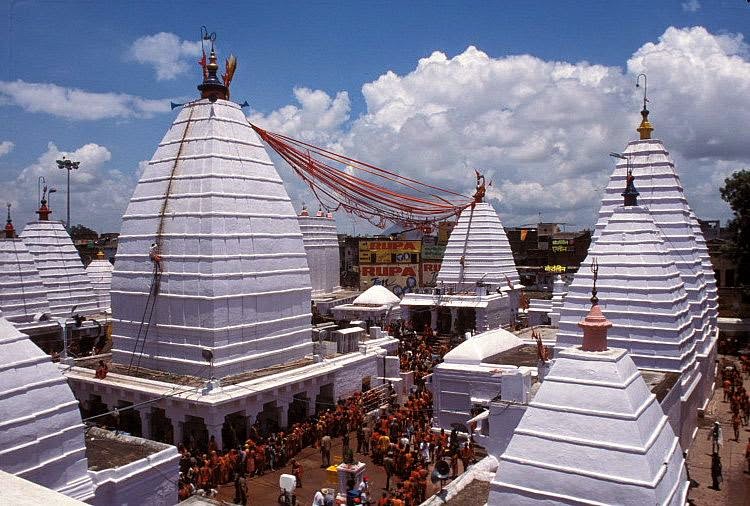
Baidyanath Jyotirlinga temple, also known as Baba dham and Baidyanath dham is one of the twelve Jyotirlingas, the most sacred abodes of Shiva. It is located in Deoghar in the Santhal Parganas division of the state of Jharkhand, India. It is a temple complex consisting of the main temple of Baba Baidyanath, where the Jyotirlinga is installed, and 21 other temples.

According to Hindu beliefs, the demon king Ravana worshipped Shiva at the current site of the temple to get the boons that he later used to wreak havoc in the world. Ravana offered his ten heads one after the another to Shiva as a sacrifice. Pleased with this, Shiva descended to cure Ravana who was injured. As he acted as a doctor, he is referred to as Vaidhya ("doctor"). From this aspect of Shiva, the temple derives its name.


Difficulty in identifying location of Baidyanath Jyotirlinga 

Baidyanatham chithabhoomau' [sivmahapuran kotirudra samhita 1/21-24] is the ancient verse that identifies location of vaidyanth jyotirlinga. According to which Baidyantham is in 'chidabhoomi', which is the ancient name of Deoghar. While, the same part of text has variation by which, verse is 'paralyam vaidyanatham', i.e., Vaidyanatham is in Parli, Maharashtra.

Thus the three temples of,


1) Baiydanath temple at Deoghar, Jharkhand,


2) Vaijnath temple at Parli, Maharashtra 


3) Baijnath temple at Baijnath, Himachal Pradesh are claiming their shrines as 'real' jyotirlinga of Vaidyanath.


In Dwadasa jyothirlinga sthothram, Adi Sankaracharya has praised Vaidyanath jyothirlinga in following verses,


Poorvothare prajwalika nidhane

sada vasantham girija sametham
surasuraradhitha padapadmam
srivaidyanatham thamaham namami
This states that Vaidyanath jyotirlinga is located at Prajwalika nidhanam (meaning funeral place i.e., chithabhoomi) in the North-Eastern part of the country. Deoghar is far located in east compared to Parli which is in west central part of the country. Also Chidabhoomi indicates that, in olden days, this was a funeral place, where corpses are burnt and post-death ceremonies were performed. This place could have been a center of tantric cults like Kapalika/Bhairava where Lord Shiva is worshipped significantly as smasan vasin (meaning, residing in crematorium), sava bhasma bhushita (meaning, smearing body with ashes of burnt bodies).

Interestingly, the same shrine of Vaidyanath is considered as on of 51 Shakti Peethas, where 'yoni peetham' of jyotirlinga itself is considered as the Shakti Peetha.


Jyotirlinga

As per Shiv Mahapuran, once Brahma (the Hindu God of creation) and Vishnu (the Hindu God of saving) had an argument in terms of supremacy of creation. To test them, Shiva pierced the three worlds as a huge endless pillar of light, the jyotirlinga. Vishnu and Brahma split their ways to downwards and upwards respectively to find the end of the light in either directions. Brahma lied that he found out the end, while Vishnu conceded his defeat. Shiva appeared as a second pillar of light and cursed Brahma that he would have no place in ceremonies while Vishnu would be worshipped till the end of eternity. The jyotirlinga is the supreme partless reality, out of which Shiva partly appears. The jyothirlinga shrines, thus are places where Shiva appeared as a fiery column of light. Originally there were believed to be 64 jyothirlingas while 12 of them are considered to be very auspicious and holy. Each of the twelve jyothirlinga sites take the name of the presiding deity - each considered different manifestation of Shiva. At all these sites, the primary image is lingam representing the beginningless and endless Stambha pillar, symbolizing the infinite nature of Shiva. The twelve jyothirlinga are Somnath in Gujarat, Mallikarjuna at Srisailam in Andra Pradesh, Mahakaleswar at Ujjain in Madhya Pradesh, Omkareshwar in Madhya Pradesh, Kedarnath in Himalayas, Bhimashankar in Maharastra, Viswanath at Varanasi in Uttar Pradesh, Triambakeshwar in Maharastra, Baidyanath at Deoghar in Jharkhand, Nageswar at Dwarka in Gujarat, Rameshwar at Rameswaram in Tamil Nadu and Grishneshwar at Aurangabad in Maharastra.

Legend


According to the stories narrated in the Shiva Purana, it was in the Treta yuga that the demon Ravana, king of Lanka, felt that his capital would not be perfect and free from enemies unless Mahadeva (Shiva) stays there forever. He paid continuous meditation to Mahadeva. Ultimately Shiva got pleased and permitted him to carry his lingam with him to Lanka. Mahadeva advised him not to place or transfer this lingam to anyone. There should not be a break in his journey to Lanka. If he deposits the lingam anywhere on the earth, in the course of his journey, it would remain fixed at that place forever. Ravana was happy as he was taking his return journey to Lanka.


The other gods objected to this plan; if Shiva went to Lanka with Ravana, then Ravana would become invincible and his evil and anti-vedic deeds would threaten the world.


On his way back from Mount Kailash, it was time for Ravana to perform sandya-vandana and he could not carry out sandya-vandha with Shiva linga in his hand and therefore searched for someone who could hold it for him. Ganesh then appeared as a shepherd who was rearing sheep nearby. Ravana requested Ganesh pretending as shepherd to hold the linga while he completes sandya-vandana and also guided him not to place the linga on ground at any movement. Ganesh warned Ravana about leaving the linga on the bank of the river and walking away if he doesn't return soon. Ganesh, pretending to be vexed by Ravena's delay, set the linga down on earth. The moment linga was kept down, it got fixed to the ground. When Ravana after returning from sandya-vandana tried to move the linga, but he could not. Ravan failed miserably in his attempt to uproot the linga. The Gods were happy with Shiva linga not reaching Ravana's place.


Shravan Mela

More than a million pilgrims visit this shrine every year. It is famous for the mela of Shraavana (a month of the Hindu calendar), between July and August. About 7 to 8 million devotees visit the place from various parts of India and offer holy water of Ganges to the deity collected from Sultangunj, which is almost 105 km from Deoghar. An unbroken line of people in saffron-dyed clothes stretches over the full 104 km for the month. The pilgrims are called Dak Bam and they do not stop even once in their journey from Sultangunj, located near Bhagalpur to Vaidyanath. Pilgrims to the temple later visit the Basukinath temple

SRI VAIDYANATH temple in Parali

Parli Vaidyanath Jyotirlinga temple
pUrvottare prajvalikAnidhAne sadA vasantaM girijAsametam |
surAsurArAdhitapAdapadmaM shrIvaidyanAthaM tamahaM namAmi ||

Vaidyanath Temple

If one is to draw a line between Kanyakumari and Ujjain, Parali village can be clearly seen on that line. This village is located on the slopes of Meru or Naganarayana Mountain. Parali is an ancient village located near three rivers, Brahma, Venu and Saraswati, because of the presence of one of the twelve JyotirLingas of Shankara, it has become famous. This village is also known as Kantipur, Madhyarekha Vaijayanti or Jayanti. It is 26 kilometers from Ambejogai in the Beed district.

History of Parali Vaidhyanath jyothirlinga temple

Yogeshwari of Ambejogai was married to Lord Vaidyanatha of Parali. But by the time the marriage party reached, the auspicious time of the wedding had passed. As a result the people of the marriage party turned into stone statues. Yogeshwari was waiting away from Parali. This is one story that is frequently heard there.
When the Gods and Demons made their combined effort in Amrit Manthan (Churning for Nectar), fourteen gems emerged. There were Dhanwantari and Amrit Ratnas in it. When the Demons rushed to grab Amrit, Lord Vishnu hid the Amrit and Dhanwantari in the Shiva Linga of Lord Shankara. Just as the Demons tried to touch the Linga, flames started emanating from the Linga. The scared Demons ran aay. But when devotees of Lord Shankara touched the Linga, there was a free flow of Amrit from the same. Even today, devotees touch the Shiva Linga as a part of taking Darshan. Here, there is no discrimination between caste, creed or color. Anyone can come and visit this place. As the Lingamurthy is supposed to have Amrit and Dhanvantari, it is also known as Amriteshwar and Dhanvantari.
“Vaidyabhyam Poojitam Satyam, Lingametat puratamam
Vaidyanathamiti prakhyatam Sarvakamapradayakam”.
The mountains and jungles and the rivers, are full of useful medicinal herbs. That is why Parali JyotirLinga is also known as Vaidyanatha.
It is here that Lord Vishnu successfully helped the Devas to obtain Amrit. Therefore, this place is also known as ‘Vaijayanti”.
Once the Demon King Ravana went to Kailasa mountain and did a severe penance to please Lord Shankara. Put up with cold, heat, rains and fine and even then when Lord Shiva did not appear before him, he began to cut his head off in order to offer it to the ShivaLinga. Then the Lord appeared after Ravana tried to offer his tenth head. He restored all of Ravana’s heads and granted him boons. Ravana expressed his desire to take Lord Shiva to Lanka as a boon. He said, “I want to take you to Lanka”. Shankara, who is very soft hearted to His devotees, agreed to accompany Ravana to Lanka. He told Ravanan, “You must carry my Linga with care and devotion, but do be careful not to put it down on the earth until you reach your destination, or else, it will stay at whichever place you put it down” Shiva cautioned.
Ravana began the journey homeward carrying the Shivaling. On the way, he wanted to relieve himself by urination. He bid a cowherd boy to hold the Linga while he relieved himself. The cowherd was not able to bear the weight of the Linga and when he could no longer hold it, he put it down on the earth. And the Shiva Linga put there stayed as Lord Shiva already ordained and came to be known as Vaidyanatheswar.
Here, the gods were sad about Ravana taking away Shiva to his Lanka. They requested saint Narada to do something. Narada met Ravana and said to him by way of praising his penance and Tapas. “You made a mistake in trusting Shiva. Believing Shiva’s word was wrong. Go to him and slander him and get your way. Go to Kailasa and move it entirely. Your success will be gauged by your art of moving Kailasa from there”. Ravana was tricked into believing Narada. Ravana promptly carried out Narada’s bidding. Lord Shiva saw the ego driven mischieves rAvaNa and told him: “A unique power is soon going to born which will destroy your pride in the strength of your arms”. Narada informed the Gods of these tidings and his success in his mission. The gods were relieved and were happy. In the meanwhile, Ravana too was happy with the boon he received from Lord Shiva. He returned and was in a trance and was under the influence of Shiva’s mythical power. He was heady and drunk with power. He decided to conquer the entire universe. To subdue his ego only God had to descend on the earth in the Avatar of Rama. Parali Vaidyanath Jyotirling mandir

Recent developments in Parli Vaidhyanath

Near Parali Village, the temple is built with stones on a high mound. The temple is surrounded on all four sides by strong walls. The insides have corridors and a courtyard. Outside the temple there is huge Deep Stambh or pillar. The main gate or the Mahadwar has a Minaret nearby. It is called a Prachi or Gawaksha, i.e., window. With the help of the location of these special prayers are held for Sun God, based on the sunrays falling through these windows, directly on to the Lingamurthy.
There is a strong, wide staircase to enter the Temple. It is called ‘Ghat’. The old Ghat was built in the year 1108.
The inner portal of the temple and the court hall are both of the same size. Therefore, the deity’s Darshan has to be done from the courtroom itself. No other place has this type of arrangement. At other places, the inner portal or the Garbhagriha is visually deep.
The Lingamurty at Vaidyanath is made of Shaligram stone. It is beautiful and very smooth and is in a benevolent attitude. On all the four sides of the temple, Nanda Deeps (lights) keep burning.
Vaidyanath temple was renovated in the year 1706 AD, by Shiva devotee Ahalyadevi Holkar. She obtained some special stones from the nearby mountain range of Trishula Devi range, which is close to Parali. This place was Ahalyadevi’s favorite.
Late Nanarao Deshpanda built the wonderful court hall of the temple. The artisans were brought from the village and with the help of the devotees. A Rama Rajeshwar Mahadev Temple too is built in memory of them near to the Vaidyanath temple. With in the premises of the Vaidyanath temple itself, there are eleven more temples for Shiva. The Veerashaiva Lingayats consider Vaidyanath Temple as the best.
Srimant Pershwa donated a large piece of land as an endowment to the temple commission. Today this establishment works through a committee. Several auspicious events are arranged here. Travelers can stay here in comfort.
Just as Parali is a place of pilgrimage for Shiva devotees, it is also a meeting point for Hari Hara. In this mixed holy place, Lord Krishna’s festivals too are celebrated along with Lord Shankara’s festivals, with great festivity. The water from the Harihar Teerth is brought for the daily worship of Vaidyanath. Every Monday devotees gather here in great numbers.
On Chaitra Padva, Vijayadashani, Tripuri Pournima, Maha Shivaratri and Vaikunth Chaturdashi, big celebrations take place. During these celebrations, there is no distinction between Bel and Tulsi. Mahadev is offered Tulsi leaves and Vishnu is offered Bel leaves. This unique practice is seen only in Vaidyanath. During the rainy season (Sravan) worship of Vaidyanath, the entire area of Parali echoes with the chanting of Rudrabhisheka Mantrochchar. The regular Puja is also done with great devotion and dedication.
Markandeya, obtained his boon of life here in Parali from Vaidyanatha. This story is from Shivapuran, Markandeya was not blessed with a long life. Yama wanted to take his life in accordance with the time of Markandeya’s life. But Shiva released him from imminent death and from Yama. A pond is named after him. It is here that this happened.
The story of Satyavan and Savitri too is based in Parali this holy place. On the Narayan mountain, the Vata Vriksh or Banyan tree of Savitri’s story, is still here to be seen. There is a temple of Vateshwara there.
King Sriyal and Queen Changuna’s dear son Chilia, came to life due to the kindness of Lord Shiva in Parali Vaidyanath.
Lord Ganesha’s idol without the usual trunk and in a sitting posture like a body builder can be seen here.
Great saints like Vakrebua, Dhundiraj, Yamaraj, Vishweswar, Guru Lingaswamy lived here. Their holy touch has made Parali even holier. It is a place of pride for Maharashtra.
“Vaidyanatheswaram NaamnaatalLinga Bhavamukheta
Prasiddham Trishulokeshuh Bhuktimukti pradamsataam
JyotirLingamidam sreshtam Darshant Poojanaadapi
Sarvapapaharam Divyam Bhuktivardhana muttamam
Maanusham durlabham Praanya Vaidyanathasya Darshanam

Na Karoti naro yastu Janma nirardhakam”.

Sponsored Links

Sponsored Links

Sponsored Links


©2009 Free Post 4 U | by Home